5 Short Steps to Freedom; Closure without Disclosure
How the Rewind can help you.
Introduction
If you are frequently distressed by flashbacks or nightmares and feel as if you are re-living specific events, if your thoughts are running out of control, if you feel constantly on edge, or indeed have lost all feeling…then you may be suffering from Post traumatic stress disorder [PTSD].
Trauma and PTSD are terms we hear quite a bit these days. We describe events as traumatic or feel traumatised by certain things. The word is linked in our collective consciousness as something intense, urgent and dangerous. But trauma also has an aspect to it that is a slow burn. It is damaging…and it is treatable. The Rewind offers a non-medical approach to the relief of these distressing symptoms.
What is trauma?
Before we can appreciate how and why the Rewind works, it helps to understand a bit about trauma. Some people believe that they can’t have PTSD because they have not experienced war, rape, violence, a catastrophic accident or a natural disaster. But many different types of events can result in trauma. You might find it hard to believe that you are traumatised, that your PTSD is real. You may feel that your experience has not been awful enough, that the events just were not terrible enough for them to be labelled as “trauma”. If there was no disaster, if no one died, how can it be traumatic? Shouldn’t you just get over it and move on?
No. Not at all. Trauma is not about the event or events. It is about the way in which memories of those events remain unprocessed and held within the subconscious, inside the nervous system. It occurs when someone is overwhelmed by threat and is unable to fight back, escape, or be soothed, leading to mind and body being continuously alert, on edge and hyper-vigilant to danger. Until these experiences are processed and can be stored along with other memories, the symptoms of PTSD will continue.
Whilst some events are widely recognised as “traumatic”, (those that are physically or emotionally hazardous), ongoing stressful events, like difficult family dynamics or a chronic, low-level sense of unsafety, can also result in trauma.

Who becomes traumatised?
Different people who are exposed to the same event will not automatically respond in the same way, so it is important to remember that what is traumatic to one person may not be traumatic to another.
For you to experience trauma, you don’t necessarily have to be the survivor of an event. You could be a witness to it without being subjected to it. Or you may have heard about what happened and then imagine it for yourself. You might be traumatised by the thoughts linked to the “what ifs” as you re-live the event over and over, adding to the narrative all the things that could have happened. Perpetrators can also be traumatised. It may surprise you that people can be traumatised by things that took place before the dawn of their conscious memory, as babies pre and post birth. All of these can result in PTSD, as the experiences remain unprocessed and the individual remains stuck, unable to move away from what happened.
How can Rewind Therapy help me?
The Rewind Technique was devised by Dr David Muss in 1989 and first published in 1991. It has become recognised as an excellent therapy for people suffering with PTSD, CPTSD and phobias, providing rapid relief from symptoms.
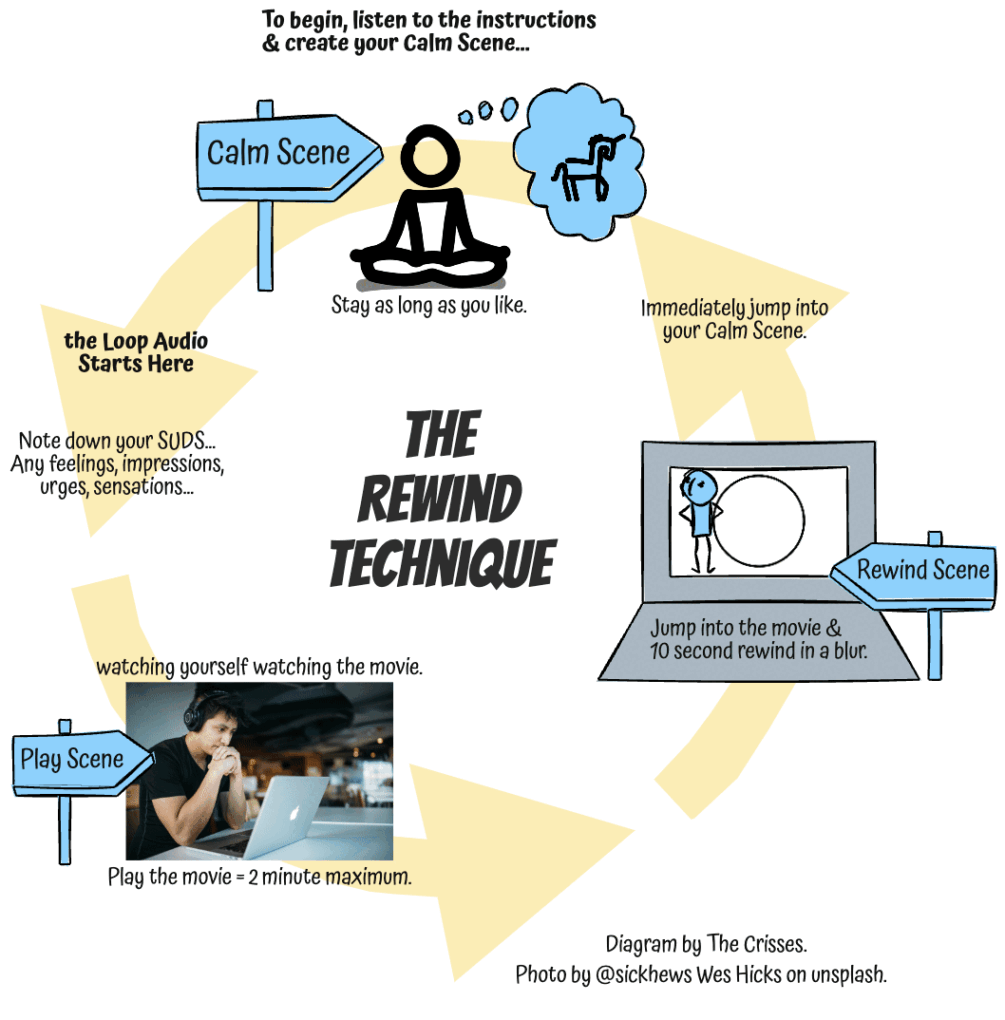
The Rewind is essentially a visualisation technique that works by unlinking the traumatic experience from all the associated emotions. It is a carefully measured and controlled way to explore traumatic memories without having to go into great detail. Once the emotions are separated from the event, the memory is effectively detraumatised. This enables it to be stored within the brain’s long-term memory, (think of it like a locked filing cabinet under your control), rather than being held in the nervous system as an ever-present threat, ready to rise to the surface unbidden. The Rewind stops that spontaneous, unwelcome recollection that involves flashbacks and nightmares. After Rewind, you can choose whether or not to access the memory.
I have used a version of rewind therapy with clients in hypnosis, for needle and dental phobias, very successfully. David Muss’ Rewind differs in that it does not require a state of hypnosis and does not require detailed exploration of the relevant events – closure without disclosure.
The Rewind therapy session
I won’t always use the Rewind during our first appointment. It might be that we have several meetings before we decide that it is the right therapy for you.
Once we have decided that your symptoms might respond well to the Rewind, I’ll ask you to complete a checklist for me (I use one called IES). This tells us, at a glance how you have been feeling and behaving during the last two weeks, how severe your symptoms are right now and whether Rewind is appropriate for you at this time. We will complete a second IES two weeks after the first Rewind, to use as a comparison.
We’ll then have a talk about how memories are stored in your brain and how trauma memories are different from other memories. I will explain to you two types of experience – dissociated and associated, using an example of something that is familiar to you, such as a roller coaster, or sledging down a hill. This will help you to understand how you can easily detach yourself from memories or imagined experiences.
After this, we will do the Rewind, where I will ask you to envisage yourself watching the traumatic memory on a screen, from the time just before the event (when everything was OK) to the end. It is tempting to leave out the really nasty parts, but it is important to include them. It doesn’t have to be factually correct, rather it has to be how you see it in your nightmares and flashbacks. This only takes around two minutes and watching it on a screen, from a position in front of it means that you can review it without reliving it. You can stop the film once every aspect of the memory we are addressing has been covered.
Then, you’ll imagine jumping into the film and rewinding it very, very fast (around ten seconds) back to where it started. You’ll watch the film forwards on the screen (we call this dissociated) and backwards as if you are in it (this is associated). This is all very quick and it is all under your control. It might take some practice. That’s fine, we can do it several times.
Once we feel you have got the technique right, we’ll book you in for your review, which will take place two weeks later. You will almost certainly notice a significant improvement in your symptoms. When you come back for your review, we can decide together if further Rewind therapy is necessary for you.
References
Adams S, Allan S. Muss’ Rewind treatment for trauma: description and multi-site pilot study. J Ment Health. 2018 Oct;27(5):468-474
Astill Wright L, Barawi K, Kitchiner N, Kitney D, Lewis C, Roberts A, Roberts NP, Simon N, Ariti C, Nussey I, Muss D, Bisson JI. Rewind for Posttraumatic Stress Disorder: A Randomised Controlled Trial. Depress Anxiety. 2023 Oct 12;2023:6279649.